


 Cart
Cart
 sales@molnova.com


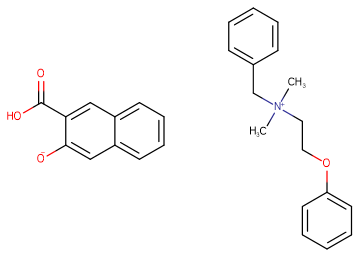
Bephenium Hydroxynaphthoate
CAS No. 3818-50-6
Bephenium Hydroxynaphthoate( —— )
Catalog No. M14321 CAS No. 3818-50-6
Bephenium hydroxynaphthoate (INN, trade names Alcopara, Alcopar, Befenium, Debefenium, Francin, Nemex) is an anthelmintic agent formerly used in the treatment of hookworm infections and ascariasis.
Purity : >98% (HPLC)
 COA
Datasheet
HNMR
HPLC
MSDS
Handing Instructions
COA
Datasheet
HNMR
HPLC
MSDS
Handing Instructions
| Size | Price / USD | Stock | Quantity |
| 100MG | 45 | In Stock |


|
| 200MG | 53 | In Stock |
|
| 500MG | 71 | In Stock |
|
| 1G | Get Quote | In Stock |
|
Biological Information
-
Product NameBephenium Hydroxynaphthoate
-
NoteResearch use only, not for human use.
-
Brief DescriptionBephenium hydroxynaphthoate (INN, trade names Alcopara, Alcopar, Befenium, Debefenium, Francin, Nemex) is an anthelmintic agent formerly used in the treatment of hookworm infections and ascariasis.
-
DescriptionBephenium hydroxynaphthoate (INN, trade names Alcopara, Alcopar, Befenium, Debefenium, Francin, Nemex) is an anthelmintic agent formerly used in the treatment of hookworm infections and ascariasis.
-
In Vitro——
-
In Vivo——
-
Synonyms——
-
PathwayOthers
-
TargetOther Targets
-
RecptorOthers
-
Research AreaInfection
-
Indication——
Chemical Information
-
CAS Number3818-50-6
-
Formula Weight443.53
-
Molecular FormulaC28H29NO4
-
Purity>98% (HPLC)
-
SolubilitySoluble in DMSO
-
SMILESOC(=O)C1=CC2=CC=CC=C2C=C1[O-].C[N+](C)(CCOC1=CC=CC=C1)CC1=CC=CC=C1
-
Chemical Name——
Shipping & Storage Information
-
Storage(-20℃)
-
ShippingWith Ice Pack
-
Stability≥ 2 years
Reference
1.MEHROTRA MP, MALAVIYA US. Indian J Med Sci. 1963 Dec;17:930-3.
molnova catalog



related products
-
SH2 Domain Ligand (1...
Ac-Asp-Tyr(PO3H2)-Val-Pro-Met-Leu-NH2 is the SH2 domain ligand. SH2 domains participate in protein tyrosine kinase (PTK)-mediated cellular signal.
-
Ajugacumbin A
Reference standards.
-
Maculosidin
Maculosidine affect the PS I electron acceptors on leaf discs, it can inhibit ATP synthesis, basal, phosphorylating and uncoupled electron transport acting as Hill reaction inhibitors on spinach chloroplasts.
